Training vs Automation in Information Governance
Oct 5, 2026
This post accompanies the TrailBlazer Learning Academy podcast episode "Training vs Automation in Information Governance" with hosts Lee Karas and Maura Dunn. Listen to the episode or play it on our podcast page.
When it comes to implementing your Information Governance program, training may not be enough
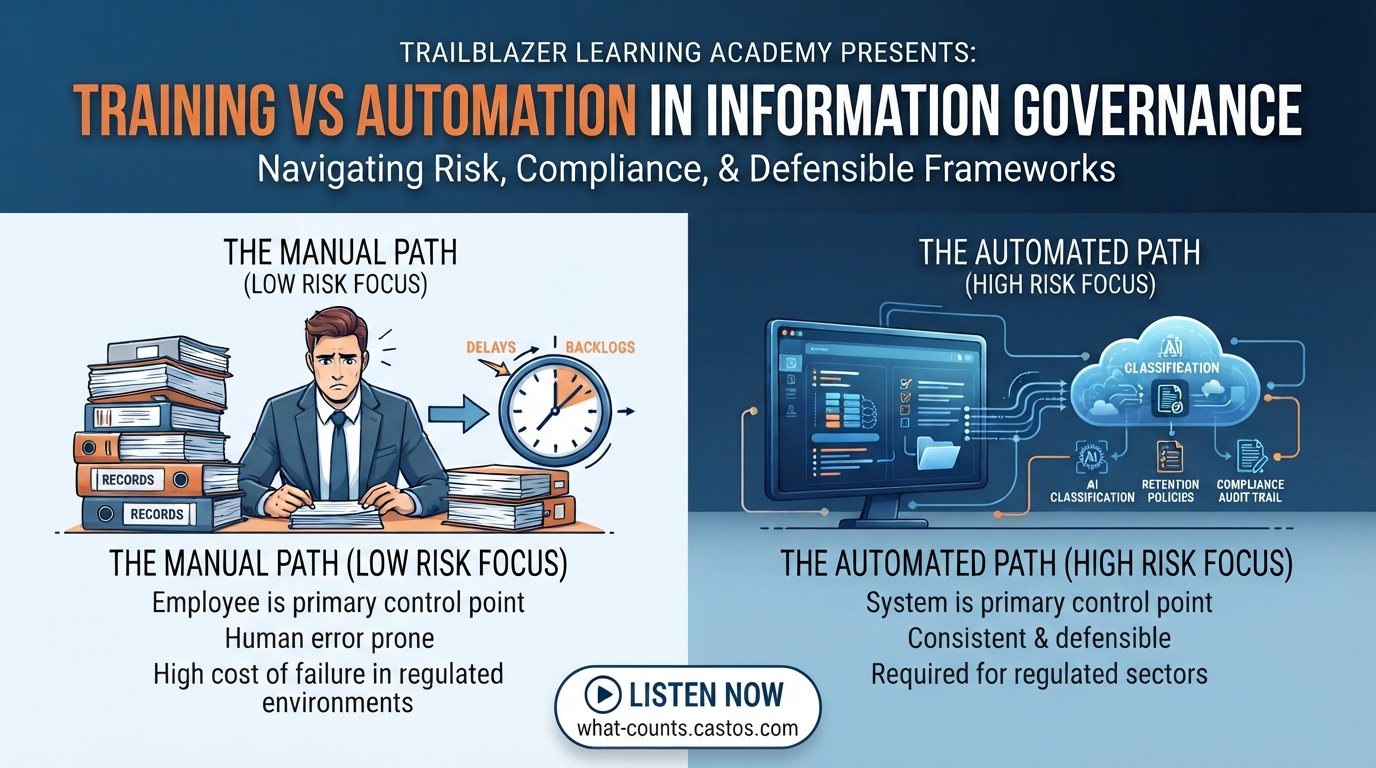
Many organizations rely on employees to identify, store, and manage company information. When the employee is the primary control point, training is paramount. However, training alone rarely sustains a mature information governance program over time. At level 1 maturity, recordkeeping depends almost entirely on individual heroic efforts. Manual filing processes inevitably break down because daily operational pressures take precedence over policy adherence.
The choice between training and automation is not a matter of software preference; it is a fundamental risk decision. Small businesses with low regulatory exposure and minimal litigation risk may reasonably rely on training to support and enforce manual efforts because the financial cost of non-compliance is low. In contrast, multinational enterprises or organizations in heavily regulated sectors cannot afford inconsistent record handling.
Key Insights from the Episode
The breakdown of manual filing: Relying on staff to file documents manually leads to backlogs and missing records, as delayed tasks rarely get completed.
Matching controls to risk profiles: Low-risk environments can justify lower-cost training models, while high-risk environments require automated controls to ensure consistency.
The cost of failure: Regulators may not accept manual search efforts as assurance of complete and accurate records. Providing an incomplete answer can lead to unexpected consequences, especially if additional information comes to light later.
Defensible proof in operations: In critical infrastructure, such as pipeline construction, captured proof of weld inspections is mandatory. Automated capture eliminates human error where missing documentation creates severe physical or financial exposure.
What to Do Next
If your organization is evaluating whether to invest in further employee training or implement automated governance tools, follow these practical steps:
Conduct a formal risk assessment: Determine the financial, legal, and regulatory consequences of missing or mismanaged records before deciding on technical solutions.
Review and update core policies: Ensure your retention schedules and information handling policies reflect current business operations before attempting to automate them.
Identify high-risk workflows: Pinpoint operational processes where human error creates unmanaged liability, such as safety inspections or regulatory disclosures, and prioritize those areas for automation.
Build a Defensible IG Framework
Before selecting tools or designing training modules, align your strategy with your organization's specific risk profile. You can benchmark your maturity level using IG Navigator and access standard policy resources in our template library.