
Records vs Non-Records: What Counts as Evidence
Aug 24, 2026
This post accompanies the opening lightning round episode of What Counts? with hosts Lee Karas and Maura Dunn. Listen to the episode or play it on our podcast page.
What the Episode Covers
Distinguishing between records and non-records is the fundamental starting point for any information governance program. Yet, many organizations never explicitly define this boundary. In this episode, Lee Karas and Maura Dunn clarify what constitutes a record and what falls outside that classification.
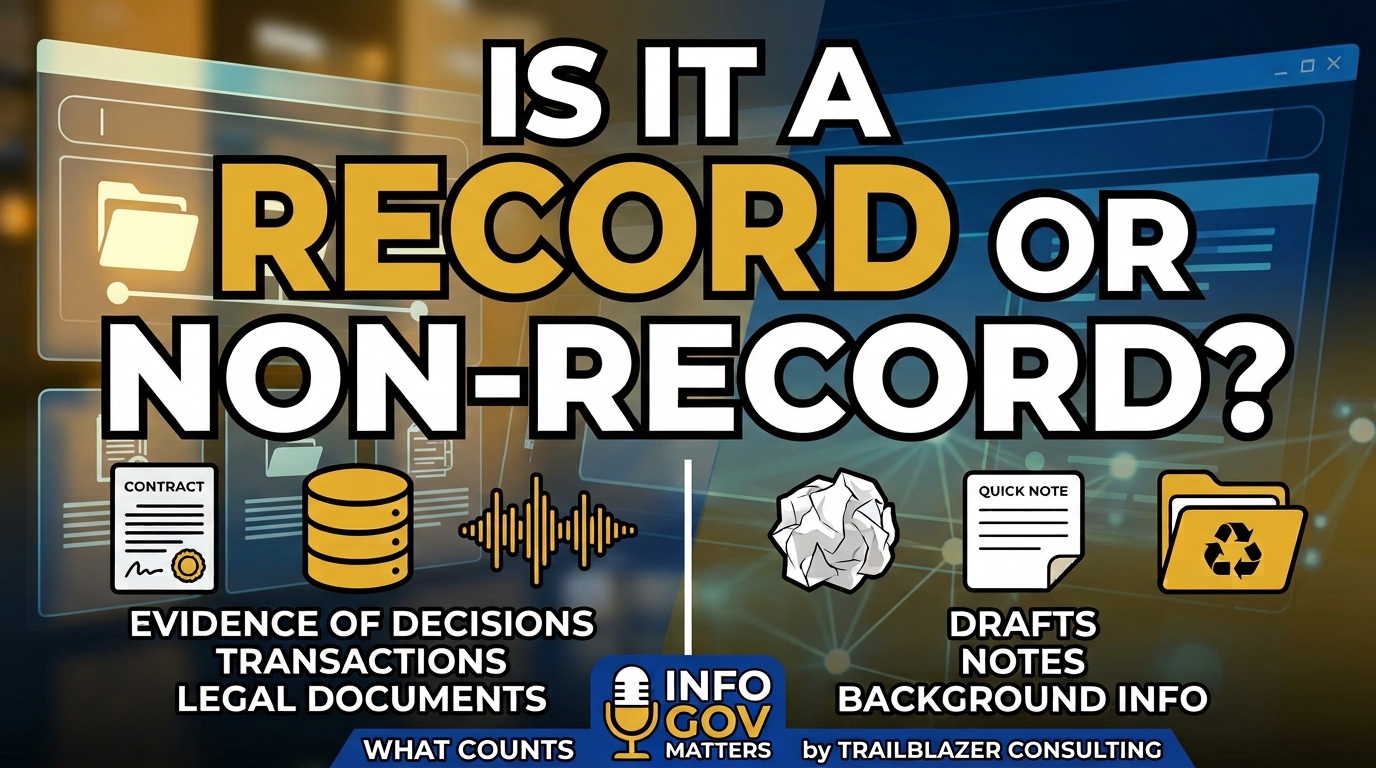
A record is any data, regardless of format, that is recorded or capable of being recorded and provides evidence of an organizational transaction, decision, policy, process, obligation, contract, agreement, legal right, or ownership interest. Format is entirely irrelevant. Structured data, digital photographs, and audio recordings all qualify if they capture evidence. Conversely, an unrecorded conversation is not a record, which is why the classic advice to get agreements in writing remains vital.
Key takeaways from the discussion include:
The standard: Maura Dunn draws the line with non-records. Discarded drafts, preliminary notes, background reading, and abandoned research are non-records because they do not reflect where the organization landed.
Citations versus source material: Published material you reference belongs to the party that originated it. Your record is the documented citation or reference within your process, not the external source document.
Process verification in practice: Using a Sarbanes-Oxley vendor verification scenario, the hosts illustrate that the record is not merely the tax identification number retrieved, but the documented proof that your team verified it.
What to Do Next
To apply these principles to your information governance program, consider taking these practical steps:
Audit your definitions: Review your current retention schedules and policy documentation to ensure records are defined by evidentiary value rather than storage location or file type.
Establish clear non-record handling: Educate business units on identifying non-record materials such as working drafts, duplicate copies, and external reference materials so they can be routinely purged.
Document verification steps: Align compliance controls to capture the act of verification or decision-making, ensuring audit trails reflect the complete process.
Operationalize your controls: Use IG Navigator to map your data assets and enforce record designations across repositories. You can also download baseline policy frameworks from our template library to update your organizational definitions.