Data Lifecycle: The Cost of Keeping Everything Forever
Oct 19, 2026
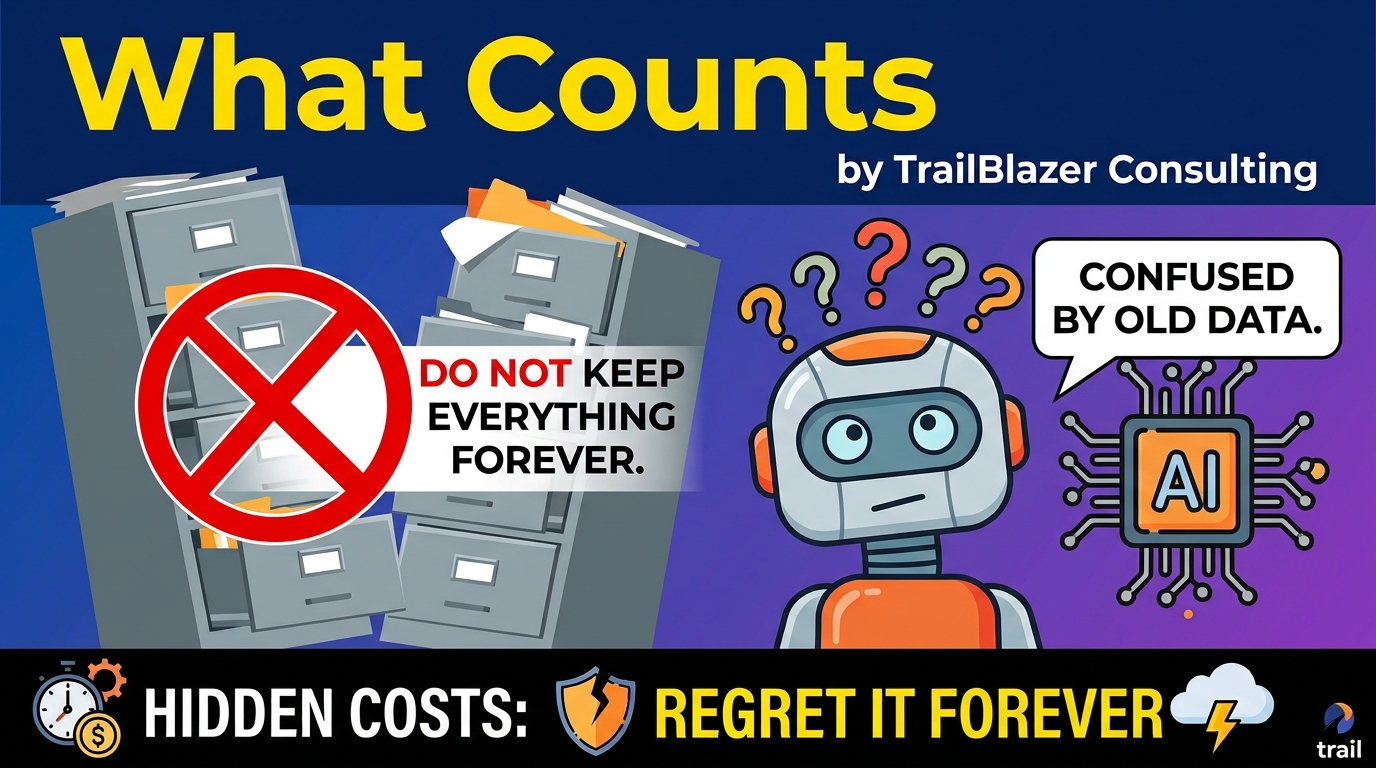
This post accompanies Episode 145 of the What Counts podcast with hosts Lee Karas and Maura Dunn. Listen to the episode or play it on our podcast page.
The Hidden Drag of Cheap Storage
A common argument against active data disposition is that cloud storage is too cheap to justify deleting anything. While the price to store each gigabyte of data may be low, the operational cost is high. Staff lose time daily hunting through duplicate versions and obsolete folders. When employees inevitably share the wrong draft with a counterparty, operational risk turns into direct business impact.
Breach Exposure, Discovery Burdens, and Privacy Mandates
Keeping data indefinitely creates severe legal and regulatory liabilities. In Episode 145, Lee Karas and Maura Dunn outline the key areas where data hoarding inflicts measurable harm:
Breach exposure: A security incident exposes legacy files that should have been destroyed years ago, inflating notification scope and regulatory exposure.
Legal discovery and audits: in the event of litigation, every responsive file you still hold must be collected, searched, reviewed, and produced. Even if a file harms your position, you must disclose it unless it was deleted in accordance with a routine retention schedule prior to the duty to preserve.
Privacy compliance: Privacy laws require organizations to state with certainty that specific data has been deleted upon request. Finding and purging every copy across unmanaged systems is nearly impossible.
Recordkeeping does not occur in a vacuum. Applying practical operational criteria, such as the food bank test discussed in the episode, helps organizations separate active records from risk-bearing digital clutter.
Why Legacy Content Feeds AI Hallucinations
The expansion of AI tools has revived the old big data myth that abandoned research hides untouched value. In reality, pointing AI tools at legacy repositories creates serious quality problems. When an algorithm scans 35 copies of a document – for example, downloaded and stored by different users or backed up, staged, and normalized prior to migration from one system to another – the frequency itself may cause the algorithm to interpret mere repetition as high relevance. If those copies include draft policies, discarded research, or contradictory versions, the AI produces confident answers built on a foundation of bad data.
As Maura Dunn concludes in the episode: keep everything forever, regret it forever.
What to Do Next
Information governance and records management practitioners must move their organizations from default retention to active, defensible disposition. To establish control over your data lifecycle:
Audit legacy repositories to identify duplicate migration copies and outdated files.
Enforce retention schedules that mandate disposition once legal and business value end.
Evaluate your program maturity and software options using IG Navigator.
Download governance policy frameworks and schedule builders from our template library.